In 1947, America Sent Food. Two Years Later, France Sent Back 49 Boxcars of Thanks.
In 1947, America—make that Americans—sent more than 700 carloads of food, medicine, fuel and clothing to Europe.
In return, just two years later, France sent back 49 boxcars filled with gratitude—one for each of the 48 states and one to be shared by Washington, D.C., and the Territory of Hawaii.
That sounds like the oversimplified version of the story. It isn’t. That’s basically what happened.
World War II had been over for two years, but Europe was still struggling to feed itself. Farms had been destroyed, transportation systems shattered and millions of people displaced. France and Italy had survived the war. Now they had to survive its aftermath.
Drew Pearson, one of America’s most widely read newspaper columnists, had recently traveled through Europe. While there, he noticed something that bothered him.
Small Soviet food shipments were arriving with banners, bands and enormous public celebrations. Meanwhile, much larger shipments of American assistance were arriving with considerably less fanfare. Europeans were eating American food without necessarily knowing where it came from.
Pearson understood that this wasn’t merely a contest over wheat. It was a contest over the story being told. The Soviet Union was selling communism. America was delivering assistance without explaining what kind of country had provided it.
So, on October 11, 1947, Pearson proposed an idea in his newspaper column and radio broadcast.
A train would travel across the United States collecting food from ordinary Americans. The supplies would then be sent to hungry Europeans, with every package making clear that it came from the American people.
This wouldn’t be the Marshall Plan. It wasn’t government-to-government assistance. It would be people helping people.
Less than a month later, the Friendship Train left Los Angeles.
It began as one train. It didn’t stay that way for long.
As it moved east, communities competed to contribute. Bakersfield supplied grain. Fresno sent raisins. Omaha added flour. Kansas reportedly contributed 83 boxcars of wheat.
The scheduled route crossed only 11 states, but all 48 eventually participated. Communities outside the route sent trucks and additional trains to meet it. By the time the collection reached New York, the original train had become several trains carrying hundreds of railroad cars.
The big donations were impressive. The small ones explained what the project actually was.
A four-year-old boy donated 400 pennies. A 73-year-old grocer contributed a sack of flour. In Nebraska, a boy reportedly offered the shirt off his back, which was promptly auctioned to raise money. A former prisoner of war organized farmers to gather corn left in their fields and used the proceeds to purchase flour.
Schoolchildren collected milk. Farmers donated wheat. Businesses supplied food, boxes and equipment.
Railroads moved the trains without charge. Truck drivers transported donations. Union workers loaded the cars. Dockworkers transferred the supplies onto ships. Shipping companies carried them across the Atlantic.
According to research compiled by Friendship Train historian Dorothy Scheele, every package included the donor’s name and address. The labels explained that Americans of different races and religions had worked together to send the food.
The message mattered as much as the flour.
The first ship left New York in December carrying more than eight million pounds of food for France. Additional ships carried supplies to Italy and other parts of Europe.
Once there, church and relief organizations distributed much of the food to children, orphans, widows, disabled veterans and elderly people in distress. Trains traveled through France and Italy carrying what American communities had collected only weeks earlier.
That could have been the end of the story.
France decided it wasn’t.
In 1948, a French railroad worker and war veteran named André Picard proposed that the French people answer America’s Friendship Train with a train of their own.
France still had little to spare. So the French gave what they had.
They donated dolls, children’s drawings, books, wine, artwork, furniture, handmade toys, clothing, needlework and family keepsakes. Some gifts had monetary value. Others were valuable only to the people who gave them up.
More than 52,000 gifts were packed into 49 small French boxcars.
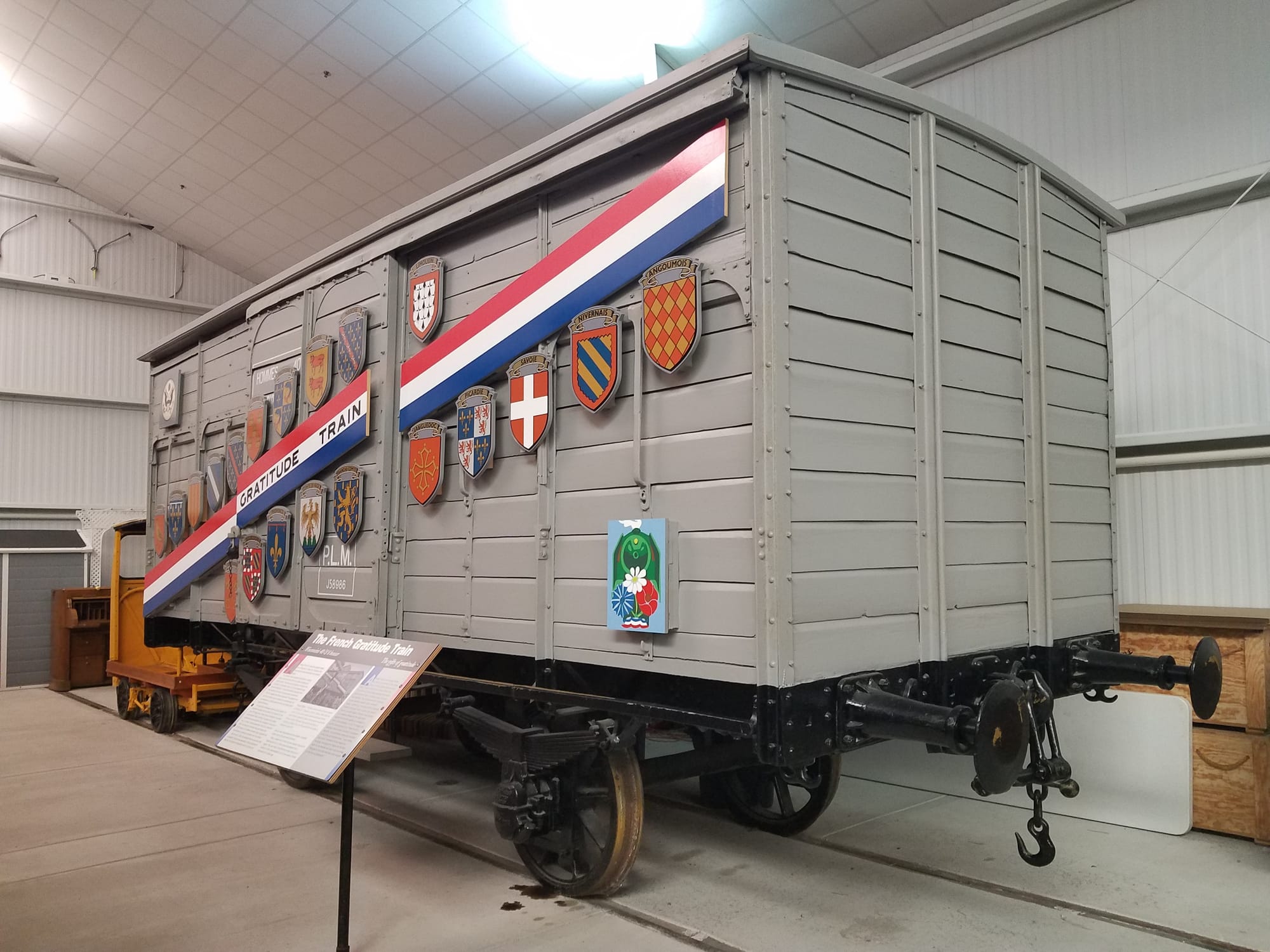
The cars carried their own history. They were known as “Forty-and-Eights” because each had once been rated to carry 40 soldiers or eight horses. American servicemen had ridden in cars like them during both world wars.
Each of America’s 48 states would receive one. The final car would be shared by Washington, D.C., and the Territory of Hawaii.
The boxcars were decorated with the coats of arms of France’s provinces, loaded aboard the French freighter Magellanand carried across the Atlantic. When the ship entered New York Harbor in February 1949, a message was painted prominently on its side:
MERCI AMERICA.
The cars were then sent across the country. Crowds gathered as each state received its piece of the train. Many of the boxcars—and thousands of the gifts they carried—remain preserved in American museums today.
America had sent what France needed.
France sent back what it could.
The first train carried food. The second carried toys, artwork, memories and pieces of people’s lives. No treaty required either exchange. No diplomatic protocol demanded it. Ordinary people simply decided that generosity deserved an answer.
Countries usually mark their relationships through wars, treaties and summits.
America and France once did it with two trains.