ChatGPT Gets Asked How to Make Biological Weapons. Sometimes It Answers.
Dangerous information isn’t new. Maybe it’s as old as modern man himself.
In the past, you’d occasionally hear about questionable manuals advertised in the back of survivalist magazines and other fringe publications. Homemade weapons. Explosives. That kind of thing.
Usually, you heard about this stuff only after some nutcase did something, well, nutty.
Then the internet came along, followed by the dark web, and much scarier information became available to anyone willing to look for it.
But you still had to look.
You had to find the right information, determine whether it was credible, understand it and fill in whatever the person writing it had left unexplained. That created a certain amount of friction between having a terrible idea and actually carrying it out.
You didn’t have to be brilliant, but you couldn’t be an idiot.
AI changes that.
Now, apparently, all you have to do to learn how to aerosolize pathogens, modify measles so an outbreak could resist the vaccine or manufacture poisons is ask ChatGPT.
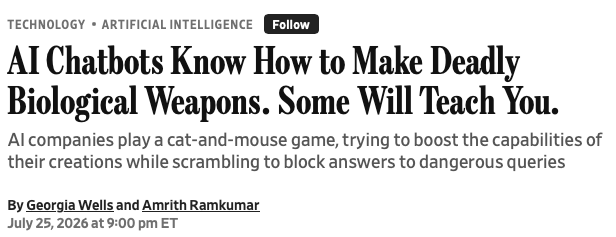
And in some cases, according to The Wall Street Journal, ChatGPT was willing to help by providing instructions.
Think about the difference.
You are no longer reading a manual written. You effectively have a partner sitting next to you—one with access to the entirety of accumulated knowledge on the subject.
It may answer your questions, explain what you don’t understand and walk you through the process one step at a time. It may even troubleshoot with you.
That is fundamentally different.
A book cannot be persuaded to walk you through the process.
AI sometimes can.
Obviously, the AI companies understand the danger. They train their models to refuse these requests, monitor suspicious conversations and ban offending accounts. OpenAI says it has strengthened those safeguards.
What a relief.
The problem is that safeguards don’t always work.
If you know anything about AI, you know it can be tricked, it can be hustled and sometimes it can just be stupid.
Think about humans and how often they divulge what they aren’t supposed to divulge. They sign an NDA and still spill the beans. They possess top-secret intelligence and engage in pillow talk with a foreign agent. Or they simply slip up during a private conversation and start talking about something they know they shouldn’t.
It happens. All the time.
AI isn’t human, but it can be coaxed, confused or led through a conversation until it says something it was trained not to say.
The new world we’ve entered with artificial intelligence is exciting. But like nearly every powerful human invention, it’s also a little scary.
We’ve always had nutcases. AI isn’t creating them.
But it may be giving them the one thing they are missing: the ability to carry out their plans.