New American Plane That Could Turn Parking Lots Into Airports.
The future of regional air travel looks remarkably like an airplane from the past.
It carries up to nine passengers and is designed to compete for trips Americans currently make by car.
The difference is where it can take off: the place where most car trips end—the parking lot.
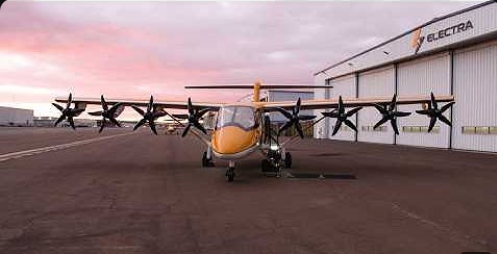
The EL9 needs just 150 feet—roughly half the length of a football field. That would allow it to operate from grass fields, converted parking lots and other unconventional locations.
That could solve one of the fundamental problems with short-distance air travel: the airport.
Flying 200 miles rarely makes sense today. By the time you drive to the airport, park, clear security, wait for the flight and find transportation at the other end, you could have driven directly to your destination.
Electra isn’t trying to make the airplane faster. It’s trying to make the airport—and its hassles—optional.
The EL9 uses eight electric motors positioned across its wings to push air over the flaps, creating enough lift to leave the ground at very low speeds. Batteries provide additional power during takeoff and landing, while a small turbine-powered generator handles cruising and recharges the batteries in flight.
That means operators wouldn’t need to build charging stations wherever the plane lands. It could arrive, pick up passengers and leave again.
The underlying technology has already flown. Electra’s smaller two-seat demonstrator has completed takeoffs and landings with approximately 150 feet of ground roll. The company is now attempting to scale that system into the nine-passenger EL9.
On Tuesday, Electra announced plans to invest $850 million in a new headquarters and production facility in Springfield, Ohio. The company says the project will create 1,975 jobs and eventually give it the capacity to build 400 aircraft a year.
There’s clearly interest. Electra says it has more than 2,200 preorders from over 60 operators, representing a potential order book worth nearly $9 billion.
If it succeeds, the result won’t merely be a quieter or more efficient airplane. It will be an airplane capable of reaching places that have never had meaningful air service—and potentially turning hundreds of miles on the highway into a short flight from somewhere nearby.